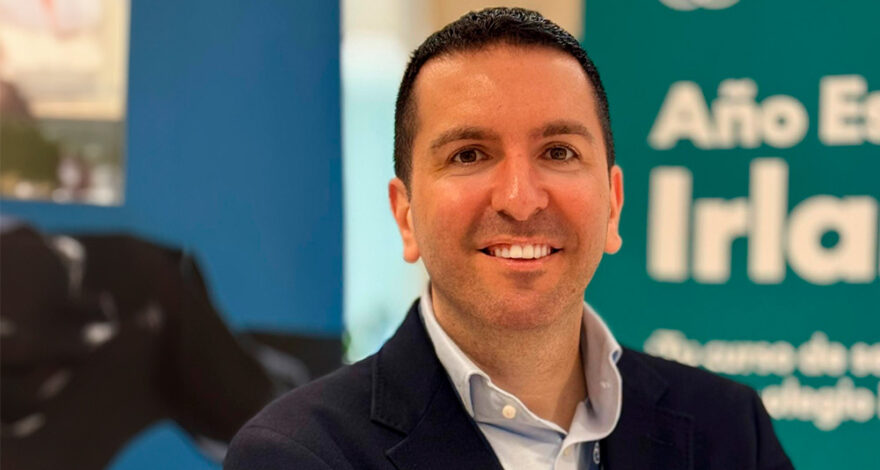
Oscar Porras Sánchez, President of the Association for 8 years, responds to ASEPROCE.
When you were studying English Philology, did you imagine yourself working in this sector?
I’ve always been very restless, and since I was a child, my father encouraged me to take programs abroad, so almost naturally I had to end up working in something connected in some way with our sector. What I never imagined was how things would unfold from a business perspective. The business world is fascinating: you know how you start, but you can never foresee the paths you will end up taking.
The last two presidents of ASEPROCE joined the organization on the same day. How do you remember that moment, and what motivated you to join the Association?
I remember it with great fondness and with absolute clarity. It was in December 2007—it’s been a while. I recall that my main motivation was to work in a professional way, to learn from established companies with a long track record, and to replicate their best practices. People were very welcoming; I remember waiting with you for the results of the voting, having dinner with Paco and Laura from Schola, meeting them for the first time. I would read everything that came from ASEPROCE twice so as not to miss a single detail. It was a beautiful period.
Since then, how has the sector evolved, and what changes do you consider most relevant?
There’s been a generational shift. Many of the entrepreneurs I met at my first assembly are no longer in the association because they have retired. I was very struck by their entrepreneurial spirit, but I think the new generation has modernized the companies. Also, back then companies were more specialized in certain programs that hardly exist anymore, such as work placements, and very few of us did school programs—now everyone does them. Things have changed, but I think the sector has become more professional.
In your early years, you joined the Executive Committee alongside a historic figure like Juanma Elizalde, and you witnessed firsthand ASEPROCE’s implosion. What was that stage like?
I was very young, not yet 30, and my company was very small, so I was more of a listener than anything else, but I learned a great deal and became very good friends with Juanma. Many of the members of that Executive Committee had strong personalities and defended their positions with great vehemence. At first the discussions surprised me a lot, and then they entertained me. That Committee included our dear friends Juan Urdiaín and Luís Cervera, who unfortunately are no longer with us. I remember them often and miss them dearly.
Later, as president, you had to lead the Association’s growth with its re-foundation and the implementation of new rules. ASEPROCE grew from 30 members to more than 70. What challenges and satisfactions did that transformation entail?
It was very intense, but the credit goes to Marta Galea, who worked like a true “warrior.” She made things very easy for me. I was very young, and she was a seasoned professional; for me, working with her was like attending a university. She respected me enormously and listened to me, just as I did with her, and I followed much of her advice without giving up my own ideas. We had to deal with unpleasant situations, but we worked as a great team. In my 8 years as president we never once raised our voices, and we became very close friends; for me, Marta is family. Then Cristina came along, a breath of joy, full of entrepreneurship, and we were fascinated by her eagerness to do things, so we kept moving forward. The culmination was the arrival of María—hardworking, meticulous, and responsible. I placed great trust in María to create a legal department for ASEPROCE, and I had no doubts. I knew she would do well, and time has proven us right. It was a difficult task because it meant replacing D. Carlos Lema, a professor at the Complutense University, with an unparalleled knowledge of our sector. He had been with the association since its founding and even drafted the very first statutes. At first, some members were resistant, but today everyone trusts her blindly. I think it was one of the best decisions the association has made.
Over time, ASEPROCE’s work has been recognized internationally. What role has the Association played at the international level?
Much more than we might think. I still serve on FELCA’s Executive Committee, and associations around the world often take us as an example in many aspects. I think the image we project is that we are a united and strong association. Members always feel that more could be done internationally, and perhaps that’s true, but this is a relationship where diplomacy is very important, and one must be cautious about how far to push. The messages we send from ASEPROCE are heard, and that’s very significant.
And then the pandemic hit. What impact did it have, and what things do you think will never be the same?
Our sector suffered greatly. For me, the first two or three weeks were terrible; I worked 16-hour days. I think I spoke with practically all of the members—people cried with me on the phone. On top of that, there were very tough personal situations, including the passing of relatives of some members. We were all very lost because we had never faced anything like this, and we were learning as we went.
I think we still need more time to fully assess the consequences, but it seems clear that the summer programs market has not returned to pre-pandemic levels. The number of host families has also dropped significantly, which has created difficulties for our providers. I believe we were all so frightened that we’ve become more cautious.
Running your own company is not the same as presiding over a business association. What were the main challenges and lessons of your eight years as president?
The most important thing is that it’s very difficult to please everyone. All the members are decision-makers in their companies and, therefore, would like their opinion to set the course for the association. It’s a role that requires a lot of diplomacy and tact. Very personal bonds are formed with people. Marta Galea and I traveled around Spain to visit some members shortly after the lockdown to encourage them, because morale was very low. The biggest lesson is that you need to know how to accompany, listen, and act without rushing. Also, to pick up the phone and call if we receive an angry email from a member—never reply in writing. Marta always said, “paper endures everything,” and I couldn’t agree more.
Now, as former president, what do you think your role within the Association should be?
None. 😊 The only thing I should do is give my point of view like any other member, albeit with the experience from the other side. I believe no one is indispensable, least of all me. I proposed to the Assembly to change the rule so as not to serve more than 8 years in the position; I think alternation is necessary.
Moreover, you are involved in FELCA (The Federation of Education and Language Consultant Associations). How do you value that experience, and what does it bring to your vision of the sector?
I enjoy attending the meetings, talking with our colleagues from other countries; it’s very interesting to see the dynamics in other places, to understand their problems, and to see how they face them. I could talk for hours about certain points that I think FELCA should work on, but I don’t want to bore our readers. 😊
Looking to the future: how do you think artificial intelligence will affect this profession?
I think it’s already having a positive impact. Our CRMs are starting to be linked to AI, and we use it more and more in our work. For me, technology is very important, and I have always tried to invest in it. It’s something that is always hard to decide: in the short term it’s an expense without return on investment—on Google, that money invested gives you leads immediately—but in the long term, there is no other way forward.
The future is not written, but we can dream it. What is your vision for the coming years?
My dream would be for this sector to reinvent itself and for us to continue to succeed. The birth rate in Spain continues to decline, which means our target audience is shrinking, even as competition increases. The level of English among young people is nothing like it was 10 years ago, and even less like 20 years ago. If we take the Nordic countries as an example, they were once the largest senders of students abroad, but their numbers have dropped dramatically over the last 10 years. I hope we can reinvent ourselves so that we continue to send many students abroad, perhaps not so much for the language itself, but for other added value propositions.