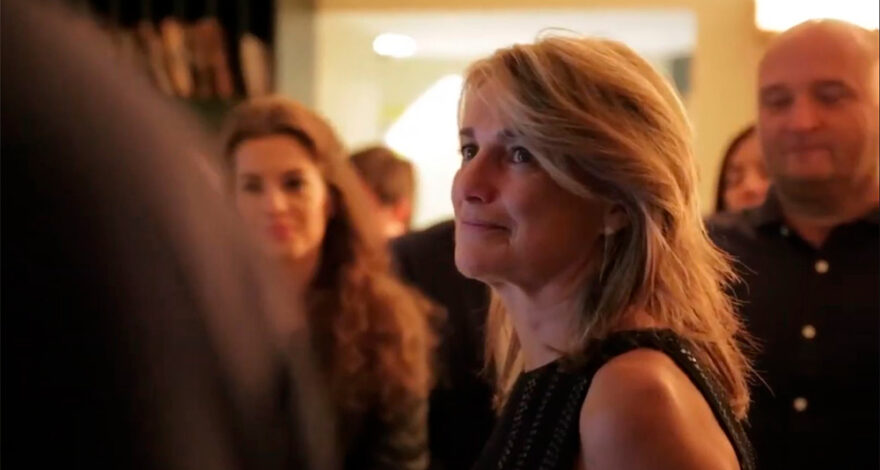
Marta Galea Rodríguez de Velasco, with a degree in Geography and History from the Autonomous University of Madrid, she has been a key figure in the 38-year history of ASEPROCE, to which she dedicated the last 15 years of her professional career.
ASEPROCE wasn’t your first experience in the sector. How did you first get started in the industry?
My beginnings were more focused on teaching, but almost at the same time, I had the opportunity to start working at JUVENTUS TRAVEL, one of the founding companies of ASEPROCE. It was a 23-year journey of collaboration and program development related to the sector—mainly academic year programs and summer courses.
You joined ASEPROCE shortly before the association’s implosion and subsequent restructuring. What was that time like from the inside?
I had known the Association since its founding, participating in all its activities. When I officially joined the Secretariat in 2009, ASEPROCE already had a 22-year trajectory and a significant number of members. It was a highly organized and professional association, playing a key role in establishing standards and ethical codes, and it was regarded as a benchmark in the sector, both nationally and internationally.
In 2013, certain circumstances surrounding the implementation of professional certification programs, which all companies were required to comply with, led to a significant drop in membership.
It was a difficult moment, and we worked very hard to save an Association that had been significantly weakened financially.
Step by step, ASEPROCE bounced back, now under the same rules for everyone.
ASEPROCE gradually recovered thanks to the help and collaboration of everyone involved—the Executive Committee and the members who stayed on, who believed in the project and in the need, among other things, to create a PROFESSIONAL CERTIFICATION known as the ASEPROCE STANDARD. It was the collective effort of everyone, who understood how vital it was to apply standards that professionalize the sector, reduce risks, and above all, strengthen the Association, in which every action benefits everyone.
For a while, you were alone in the office, which has since grown into a solid team.
Yes, it’s true—I was physically alone in the office for two years, although I always had the Executive Committee behind me, ready to help whenever necessary. And with the active participation of the members, things steadily improved. More companies joined, more initiatives were developed, which led to the additions of Cristina Rivaya, María Calleja, and more recently, Simone Cruz to the Secretariat. This definitely brought a significant improvement—not just in terms of organizational efficiency, but also in helping the Association move forward and thrive toward a shared goal.
The Workshop has also become a major milestone in your journey. How did it start and evolve into a benchmark event?
In the search for more activities to give the Association greater substance—and to generate additional revenue—we began inviting schools to present their programs during General Assemblies or internal meetings. This started around 2012, and by 2014, we organized the first ASEPROCE WORKSHOP, with 15 IALC schools participating. Today, it’s one of the Association’s most important events, organized with a high level of professionalism and already established as a national and international benchmark in the sector.
Three presidents, each with very different personalities—but very close friends.
I’ve worked with three presidents: Juan Manuel Elizalde, Óscar Porras, and Pablo Martínez de Velasco. Of course, they were different—not just in personality but also in the challenges and projects each one took on. Some had to face very unique and difficult situations. What stands out is their deep involvement and the strong harmony between them, with a clear intent to collaborate, support, protect, and improve the member companies and the sector as a whole.
Would you say that camaraderie and friendship among the members are among your greatest achievements? For us, your tact and mediation have always been more valued than even your vast sector knowledge.
Being part of an association means joining forces and sharing ideals, with collaboration as the foundation. This collaboration isn’t only about working professionally to defend the interests of the companies and the sector overall—it’s also about responding to the more specific needs of individual members. That’s why encouraging camaraderie and friendship among members has helped create a very positive environment, which made my work much easier and more rewarding.
The pandemic was the ultimate test for the Association, and yet, we seem to have come out stronger—though not everyone made it through.
The pandemic was an extraordinary situation, with a social, economic, and political impact that triggered a severe global crisis. In this unprecedented context, ASEPROCE showed its best side. Unity, information sharing, and mutual support allowed us to prove just how valuable an Association can be.
And without a doubt, we came out stronger—at least with more experience in handling critical situations and a remarkable ability to bounce back.
Since you left nearly a year ago, the world seems more uncertain and dangerous.
I don’t think this past year has been much different from other tough times. After 40 years of working, I’ve lived through many “difficult” moments: wars, pandemics, terrorist attacks, or government policies that impacted both the world in general and our sector in particular.
I do believe, to some extent, in the power of bad news—this pessimistic outlook that’s not just caused by current events but also by the increasing focus the media places on negative stories.
Admit it—you miss the action a little. Those of us who know you can’t picture you at home doing puzzles. You must still be living at full speed.
In this new chapter, I’m making the most of my free time traveling, studying, and enjoying time with family and friends. I do have to admit—I miss my former colleagues, members, and friends. In the end, that’s what truly matters.