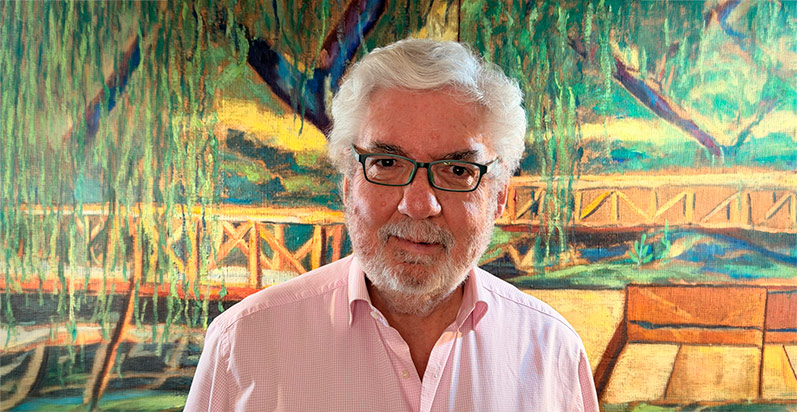
Clodoaldo Casaseca, internationally known as Clodo, was President of ASEPROCE from 1996 to 1999. CEO and founder of Sheffield Centre. A native of Madrid, intelligent, intuitive, and charismatic, with an explosive personality, he is a true benchmark in the sector.
Clodoaldo, a name of Germanic origin meaning “the one who rules with glory.” Did your parents have high expectations for you?
My parents used to despair because I was never a good student; in fact, I attended quite a few schools. However, one day it was time to get serious, and my parents were proud of my professional career; in the end, I gave them the satisfaction they had dreamed of.
Having studied Marketing at CEU San Pablo in Madrid, what kind of company did you imagine yourself working for in the future?
At first, I wanted to become an airline pilot, but my myopia ruled that out. We’re talking about a time when eye surgery did not exist. So I thought: “I will have my own company.” And that’s what happened. I’ve had quite a few businesses: some good, and some very good.
How did you end up founding your company in this sector?
At that time, traveling to London was a real luxury. It cost one hundred thousand pesetas when salaries were thirty thousand. Youth travel programs didn’t exist yet; they were just beginning to emerge. I decided to create my agency to make affordable travel possible for young people, so they could travel and discover the world. That’s how the idea of entering the sector was born.
Oxford and Cambridge are often used as brand names in the UK. Why did you call it Sheffield Centre?
The idea came from my partner, who had just returned from studying in Sheffield. We decided to use the city’s name. There was no internet, no email, no SMS… everything was found in the Yellow Pages. And writing “Sheffield” is extremely complicated. We received letters addressed to “Sefil.” But we decided on it and have kept it to this day. If I had to start today, I wouldn’t call it SHEFFIELD.
Going to Sheffield in the 1980s must have been quite an experience during the major conflicts against Margaret Thatcher.
Sheffield was a very important industrial city and the industrial restructuring was extremely tough. It went from being a very polluted city to the cleanest city in England. To combat pollution, many parks and gardens were created. The blast furnaces disappeared, but the parks remained. It was an open, safe, and peaceful city, with two very strong universities. The student population was enormous, which offered advantages to Spanish students: discounts, concerts, events… It was a lively city.
You were President of ASEPROCE from 1996 to 1999. What were the challenges and achievements of that time?
The day after I was elected, four companies withdrew from the association. We were left with 22 members, if I remember correctly. The sector had a terrible reputation: there had been significant fraud cases where companies took the money and disappeared. We focused on strengthening the ASEPROCE brand as a guarantee of seriousness and reliability. We incorporated prestigious organizations, held presentations in Barcelona and Madrid, and worked to professionalize the sector and gain strength to negotiate with institutions. I remember the first press conference: we didn’t know if anyone would show up, and several TV channels, radio stations, agencies, and newspapers came. We began collaborating with embassies, tourism offices, seeking sponsorships, agreements with insurers, airlines, exhibition venues… They were difficult years, but they laid the foundations for the ASEPROCE we know today. I left the association with more than 70 members.
You had 17 years away from ASEPROCE, but now you are back home.
Yes, indeed. I believe ASEPROCE is doing very well, and we have very complicated challenges ahead; without a doubt, unity and sector strength are key to everyone’s future. The sector is changing at a rapid pace, and we continue to be highly sensitive to both external and internal events. We must ensure that studying abroad becomes something essential, and I have returned with the enthusiasm to help in whatever is necessary to achieve that.
You have also invested in schools in Madrid. It seems many people have now decided to follow your example.
Currently, we have a school in Madrid, Willoughby, a boutique school with excellent results. In the past, we also had Internacional Aravaca, a school created from scratch that we turned into a top-level institution. If I were younger, we would have more schools, but a school needs time — 10 or 12 years — to build prestige, and right now I lack many things except time. Large European and American investment funds are making strong investments in the education sector, both school and university, involving very significant amounts of money.
We’ve been through everything, including a pandemic. Do only the strongest survive?
The pandemic was brutal: two very difficult years, the first disastrous and the second very bad — terrible. Maintaining jobs, offices, and schools was extremely complicated and required enormous economic and mental effort.
It seems a new world order is emerging. How do you see the future?
The future in our sector is very complicated. Companies have focused heavily on the Academic Year Abroad, and as always, we begin a price and discount war; the situation can become impossible. What would happen if the United States canceled the J1 visa? Sometimes we need to be careful and stay under the radar, not make too much noise. I experienced the situation when Spain decided to eliminate the university entrance exam recognition for students studying abroad — it was a catastrophe. That’s why I fear that some misguided politician — and we have many — might decide that studying abroad is a privilege for the wealthy and stop recognizing those studies… I don’t even want to think about it.
Are the people who run the world scarier than artificial intelligence?
Artificial intelligence is an excellent tool; it’s here to stay and is certainly the future, whether we like it or not. I remember being 12 years old when I was given a “Casio” calculator with the four basic operations; people said it would make our brains lazy. The people who run the world can often be frightening, and in the free world they usually leave after a few years — although some come back… and my goodness.
“Bocata time” — the Friday sandwich videos that have gone viral. One of those accidental ideas that turned into something bigger?
On Fridays, at the end of the week, I started inviting everyone to a ham sandwich as a friendly gesture and to take a one-hour break where all departments could gather. We’ve been doing it for nearly 25 years. When social media arrived, I wanted to learn and, since I didn’t know what to post, I started recording “bocata time.” What began as an experiment has stayed. Believe it or not, people stop me in the street to take pictures with me. I’ve just returned from Punta Cana and the waiters asked to record a “bocata time” with them.
“Never trust anyone who doesn’t drink wine” is one of your favorite phrases.
Hahaha, yes — it’s a phrase without bad intentions, although some may interpret it differently. It came from a girl who worked with me who said she would never drink wine, and I jokingly replied that a person who doesn’t drink wine can’t be trusted. It was a joke, and it stuck.
Spanish wine, of course.
Of course. We should promote local products, and in Spain we have excellent wine. Through my work I have visited many countries and regions, and Spanish wine is outstanding. I’m a big enthusiast; I even had a winery with some friends. But the wine was so bad that I donated the 150 liters that belonged to me to the town festivals.
You’ve been in the sector for 39 years. Until when?
This year I turn 64 and I feel very comfortable working. I continue with my visits, my business lunches… For now, I haven’t thought about retiring. But you never know. Everything has an end, although I don’t have a date.
Interview conducted by Pablo Martínez de Velasco Astray, President of ASEPROCE